To scale TikTok ads is to spend more on a winner without breaking the delivery that made it win. The job splits in two: vertical scaling (spend more through the ad group that already works) and horizontal scaling (rebuild that winner across new ad groups, audiences and geos). A rules engine can run the first one. The second is ad-building at volume, by hand, and it is where the afternoons go.
TL;DR
- The gate: scale a conversion ad group once it has "at least 50 conversions within a week" and the campaign meets or exceeds your performance metrics (TikTok Ads Manager help, checked 15 November 2026).
- Vertical moves in 20-30% steps, and delivery typically needs 2-3 days to settle after each one (admetrics.io).
- Horizontal hits a hard floor: TikTok requires a daily budget above $20 per ad group and above $50 per campaign (TikTok Ads Manager help). Scaling wide means building many small units.
- TikTok's native Automated Rules run the budget half for you (TikTok Ads Manager help). Third-party engines, ours included, run the same loop across Meta and TikTok, with OR-logic and Slack alerts on top.
- First-hand: I took a casual gaming app from roughly $200/day to $15,000-20,000/day on TikTok in one quarter. Creative supply and localization made that survivable, not the size of the budget steps.
Your TikTok ad is finally working. Now the babysitting starts
You found the winner. ROAS holds three days straight, and instead of relaxing you open Ads Manager every two hours to nudge a number.
A media buyer on r/PPC put the job in one sentence back in 2018: "Currently managing 20-30 ad sets and I am interested in automating our budget adjusting process so that it is less manual" (r/PPC). The same question runs in r/TikTokAds today: "Should I create a new campaign specifically for scaling, or continue in the current one?" (r/TikTokAds).
Both ask the same thing: which part of this is a decision, and which part is just work? Separating the two is the whole game.
When is a TikTok ad actually ready to scale?
A TikTok ad group is ready to scale when it has enough conversion history for the delivery system to keep optimising through a budget change. TikTok puts a number on it: for conversion campaigns you can start to scale when an ad group generates "at least 50 conversions within a week" and the campaign meets or exceeds your performance metrics (TikTok Ads Manager help, checked 15 November 2026).
For non-conversion campaigns, ad groups "should be spending 90-100% of their budget" with cost per action at or below target (same source). Budget you cannot spend is a delivery problem, and more budget will not fix it.
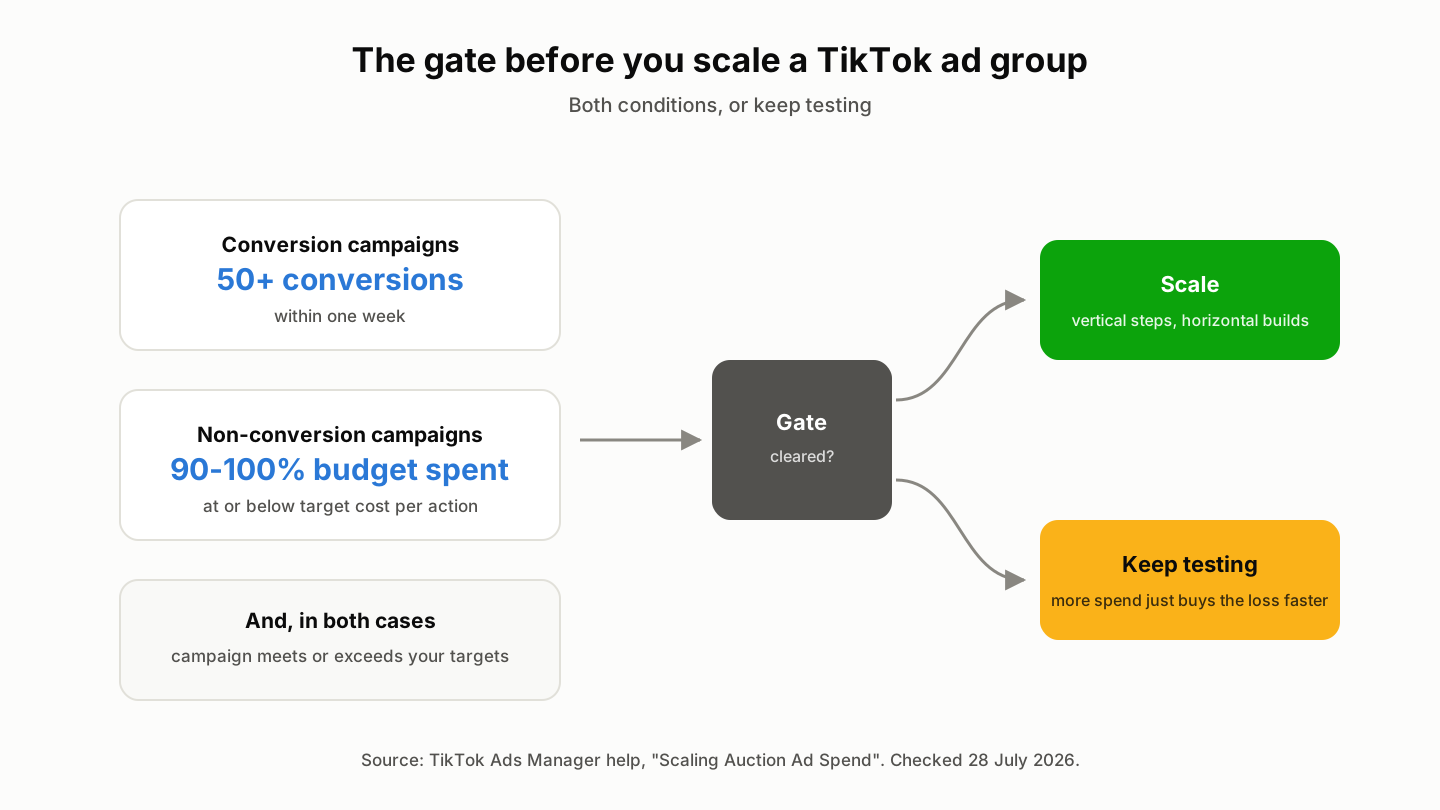
Scaling a winner that never cleared the gate just buys losses faster.
The community heuristic is looser: 7-14 days of consistent profitability (admetrics.io). That is a time gate, not a volume gate, and at low daily spend the two can be weeks apart. Use the conversion count as the real gate.
Vertical vs horizontal scaling on TikTok
Scaling a winning TikTok ad group works two ways:
- Vertical scaling: raise the daily budget on the ad group that already works, in 20-30% steps (admetrics.io).
- Horizontal scaling: copy that winner into new ad groups, audiences or geos, so spend rises without any single ad group taking a large step.
Vertical is one decision on a timer. Horizontal is one decision followed by a lot of building.
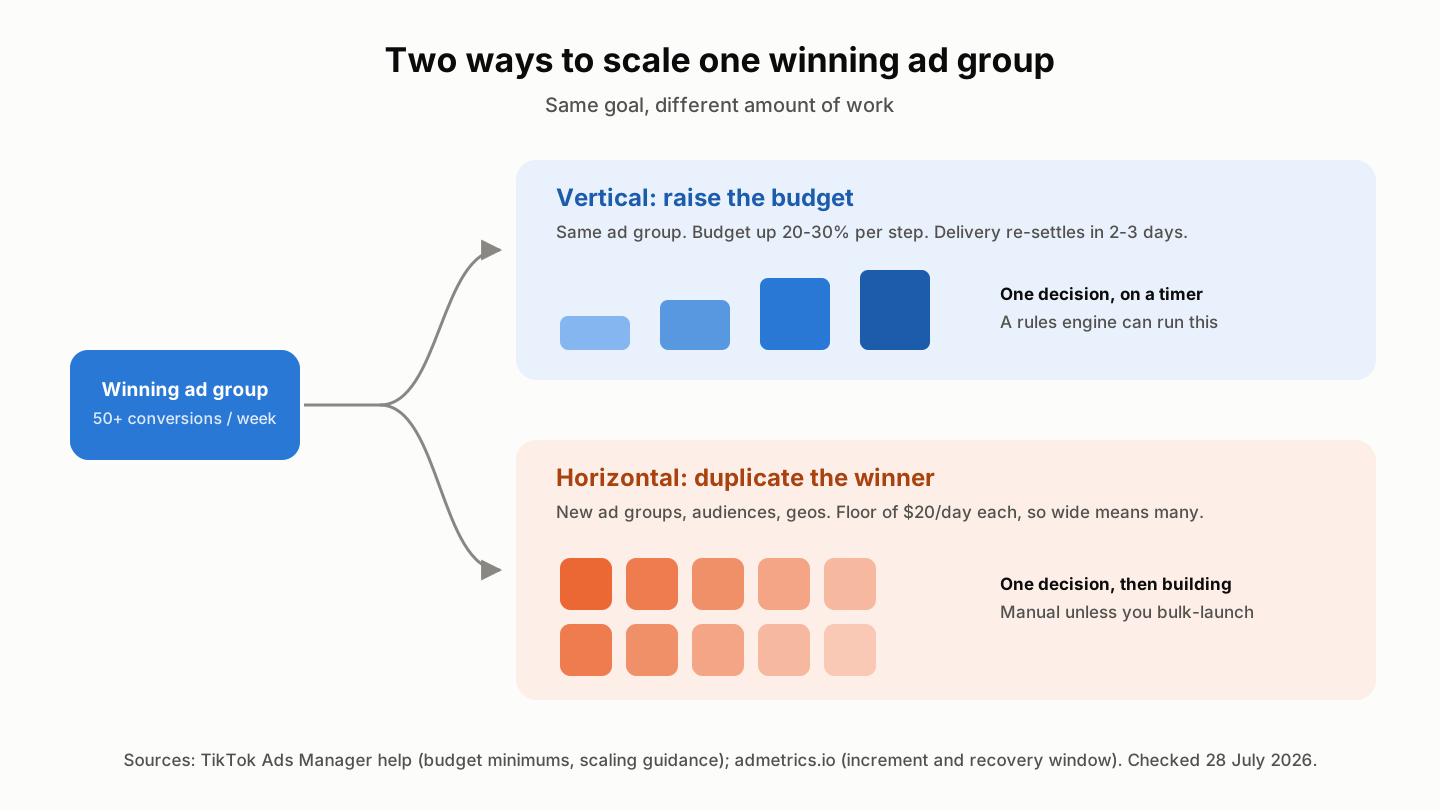
Vertical spends more. Horizontal builds more. Only one of them costs you an afternoon.
Vertical: raise the budget on what already works
You raise the daily budget on the winning ad group and wait. Delivery re-optimises, and performance normally settles after 2-3 days (admetrics.io). Step too hard and you push the ad group back into learning, which is the reset everyone is trying to avoid.
Why bigger steps hurt is mechanical. As a practitioner in r/FacebookAds put it: "When you 2X your spend… 2X the impressions, 2X the views, 2X the people you reach" (r/FacebookAds). Doubling the budget does not double audience quality. It reaches further down the same list.
Horizontal: duplicate the winner into new ad groups
You rebuild the winning creative against new audiences, geos and placements, usually alongside small vertical steps: "increase by 20% every second day. scaling horizontally, meaning add more ad groups so you don't risk killing…" (r/dropshipping).
No single ad group takes a big step, so nothing gets pushed into a fresh learning phase. The cost is just as real: somebody has to build all of it. The largest TikTok scale-up I have run went this way, expanding worldwide instead of pushing more budget through the geos we already had (first-party, my own UA practice). The decisions stayed simple. The building did not — and the creatives have to exist in both accounts first, a chore we covered in bulk upload creatives to Meta and TikTok.
The floor that shapes your structure: $20 per day per ad group
TikTok sets a minimum daily budget above $20 at ad group level and above $50 at campaign level; lifetime budgets are that $20 minimum multiplied by the scheduled days (TikTok Ads Manager help, checked 15 November 2026).
That floor quietly designs your account. Testing eight audiences horizontally costs $160 a day minimum. Going wide on TikTok is not a budget slider. It is a build order.
How much, how often? The 20% rule and why the numbers disagree
There is no single correct increment. The spread from sources that put a number on record:
| Source | Increment | Cadence | Type |
|---|---|---|---|
| admetrics.io | 20-30% | per increase | Vendor guide |
| Anstrex (published 15 February 2024) | 20-50% | "each time" | Vendor guide |
| r/TikTokAds | 50% | every 3-4 days | Community claim |
| r/TikTokAds | 20%, gradual | unspecified | Community claim |
| r/dropshipping | 20% | every second day | Community claim |
| r/TikTokAds | 50% | every hour, CBO | Community claim |
The Reddit rows are practitioner claims from live threads, not benchmarks.
Our read: the percentage is not the variable that matters. What matters is whether your conversion volume can absorb the new spend without delivery losing its signal. A 50% step on an ad group doing 200 conversions a week is a smaller shock than a 20% step on one doing 55. Size the step against your conversion count. Results vary by account setup, niche, and budget.
What you can actually automate
The two halves are not equally solved, and the gap is wider than most guides admit.
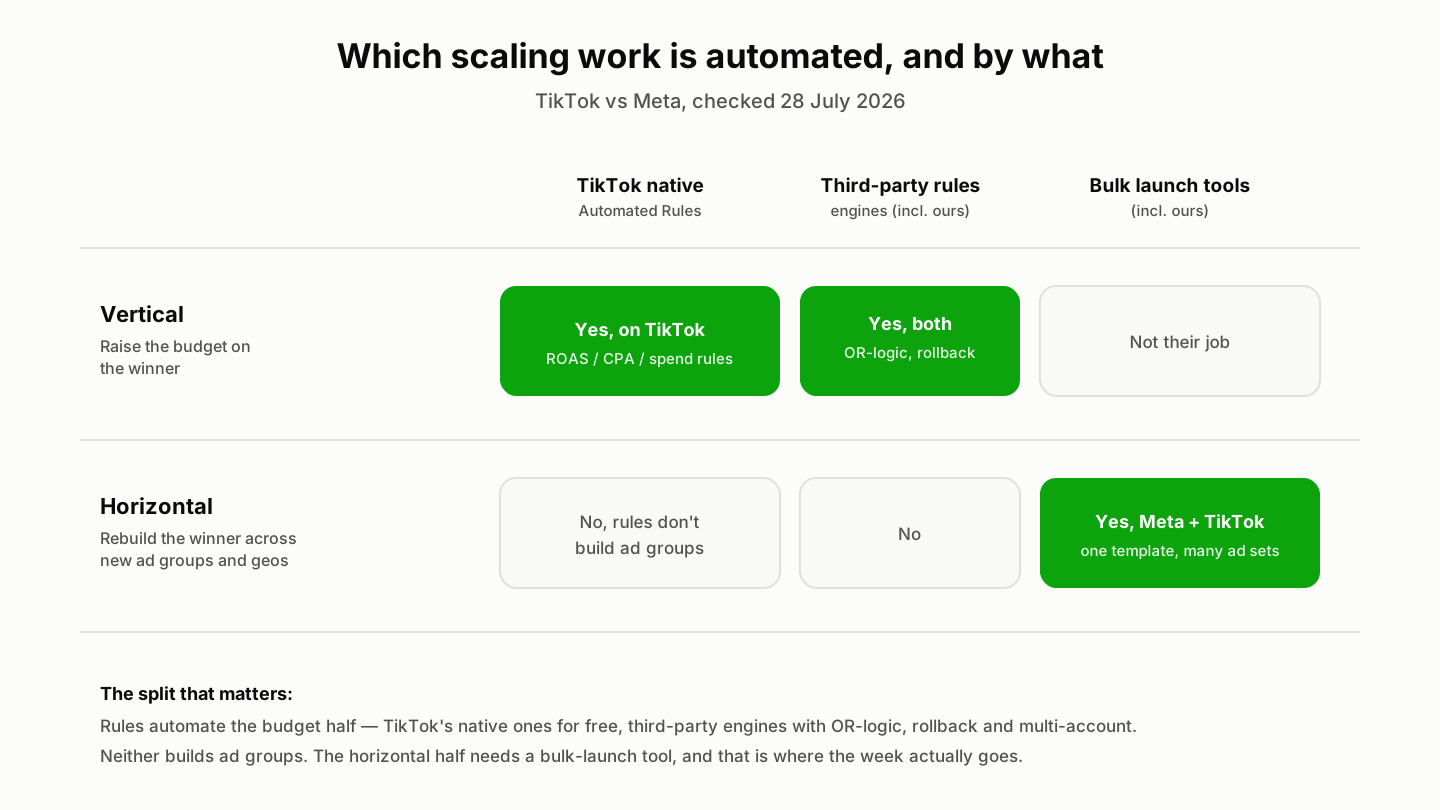
The budget half automates either way. The building half is where the hours hide.
TikTok's native Automated Rules
TikTok Ads Manager has a rules engine built in. Automated rules "let you create rule-based tasks to automatically check and manage your campaigns, ad groups, and ads": you set the criteria that trigger the rule, the action it takes, and what it affects (TikTok Ads Manager help, checked 15 November 2026).
TikTok's own examples map onto vertical scaling:
- "Receive notifications by email when your campaigns have spent 80% of their lifetime budget"
- "Pause a low-performing ad when it hits a particular metric"
- "Increase your budget based on return on ad spend (ROAS)"
That last one is the whole vertical-scaling loop, running without you. If you still open Ads Manager every two hours to raise a budget by 20%, you are doing a job TikTok does for free.
Where third-party tools fit, and where they don't
Plenty of third-party platforms sell rules engines on top of the ad platforms. Ours is one of them: Scalemate's rule-based campaign automation runs the same rules engine across Meta and TikTok — pausing low-ROAS ads, scaling winners, protecting daily budget on a schedule. What that adds over the native version is control: AND/OR condition groups, budget and bid changes in absolute or percentage steps, cross-account management, and Slack alerts when a rule fires, run as one rule instead of five (ready-made rule templates, checked 28 July 2026). If all you need is one budget bump on one account, TikTok's native rules already do that for free, and you should use them.
What a rules engine buys is volume rather than convenience. Appflame, an app publisher running Meta UA, reports 750 losing ads stopped per month and 575 rule firings per month through our rules engine (Scalemate case study, figures live on the page 15 November 2026, Meta-side). Nobody makes 575 correct decisions a month by hand. That number comes off a Meta account and I am not going to dress it up as a TikTok result — but the loop being automated is the same one on either platform.
The half nobody automates: rebuilding the winner 30 times
Vertical scaling is solved on TikTok. Horizontal is not, and it is the half that eats the week.
Work the arithmetic. One winning concept, six audiences, three geos, two formats. That is 36 ad groups, each needing its own creative assignment, targeting, and budget above the $20 floor. None of it is a decision. All of it is typing.
This is the part a bulk-launch tool removes, and no rules engine touches it on either platform. Scalemate can launch ad sets in bulk from one template on both Meta and TikTok: one template producing 150 ad sets on Meta and 75 on TikTok, and 225 ads created in 3 minutes, against a manual baseline of 3-5 days per launch (figures live on the page 15 November 2026).
Note what that does not claim. It decides nothing. It builds what you already decided.
What $200/day to $20,000/day actually took
The clearest version of this split was my own account, and no tool was involved in it. I ran UA for a casual gaming app, worldwide, on Android and iOS. Over one quarter TikTok went from around $200/day to $15,000-20,000/day in spend, at a lower CPI than Facebook and at positive ROAS (first-party, my own UA practice). It moved from a test line to a top-3 channel, and in strong-winner seasons top-1 on iOS.
I would not hand anyone that multiple as a forecast. Where the work went is the part worth copying.
The ceiling was creative supply, not budget
At that spend level a winning concept burns out in days, not weeks. Feeding it took two production lines at once: TikTok's own brief-based creator programme, plus in-house production for everything the programme could not cover.
That programme is the one advertisers used to call TTCC. It now runs as the Creative Challenge project type inside TikTok One, where creators join by open application and are paid on a performance basis (TikTok One project types, checked 28 July 2026). One brief goes out, video comes back from many creators at once. Budget was never the constraint. Usable creative volume was, every week.
Localization did more than translation
We localized into German, Japanese and Spanish, and the versions that worked were made by creators from those markets, not translated voiceovers over the same footage. Same offer, different hooks, different pacing, different faces. Dubbed versions underperformed consistently enough that we stopped making them. I have no clean number for that, but directionally it separated a geo that could absorb budget from one that stalled.
Retesting the optimization goal: purchase ROAS vs ad revenue ROAS
A casual game earns two ways, through in-app purchases and through ad revenue, so we retested both goals instead of assuming the purchase goal was right. TikTok's value-based optimization for app lets you optimize on purchase value or ad revenue value, and reports Purchase ROAS and Ad Revenue ROAS separately (TikTok Ads Manager help, checked 28 July 2026).
One correction to my own notes: when I ran this, ad revenue optimization was Android-only for me. TikTok's documentation today says it "is available for Android and iOS app campaigns" (checked 28 July 2026). Confirm it in your own account.
All of it by hand, and what I would automate now
No automation ran on that account. Every budget increase, every duplicated ad group, every localized variant was done manually.
That is why I am sure which half is which. The budget half was never the hard part: read a metric, compare it to a threshold, change a number. It is the job TikTok's native Automated Rules do, and I was doing it off a calendar reminder.
The rebuilding ate the quarter. Worldwide geos, three locales, a creative stream that never stopped, every combination rebuilt into new ad groups by hand. None of it needed judgement after the first version. It needed hands.
Five ways scaling breaks
- Learning-phase reset from an oversized jump. Delivery needs 2-3 days to re-optimise (admetrics.io). Stack a second increase before it settles and you get a clean read on neither.
- Audience overlap from duplicating too wide. Six lookalikes off one seed puts your ad groups in an auction against each other; a lookalike source needs at least 100 users (Anstrex, February 2024).
- Creative fatigue at 14-21 days. The reported window for a TikTok creative to wear out (Anstrex, February 2024). Adding spend in week three accelerates the decline, not the revenue.
- Scaling a winner that never cleared the gate. Three good days is not 50 conversions in a week (TikTok Ads Manager help). Below that volume you are scaling noise.
- Lowest-cost bidding spending to budget instead of to margin. Under standard bidding the goal is to spend what you gave it (r/TikTokAds). If your margin depends on a CPA ceiling, set a cost cap.
Scale the decisions and the building separately
Put the budget side on rules, native or ours, so vertical scaling runs on a condition instead of your attention. Then stop hand-building the horizontal side, because that is the part costing you days. Rules for the decisions, bulk building for everything else: that is what we built Scalemate to do.
TikTok scaling, budget and Automated Rules figures and Scalemate product figures were re-checked against the live sources on 15 November 2026. Results vary by account setup, niche, and budget.