AdCreative.ai generates ad creatives with AI — static banners, copy variations, and performance scores based on conversion data from thousands of campaigns. It can push finished creatives directly to Meta Ads Manager. But it does not build campaigns, set budgets, or manage performance. The actual testing — launching variations, pausing losers, scaling winners — still happens manually. This article covers the best alternatives depending on what you need: stronger creative generation, or the operational layer that turns creatives into results.
In this article:
- What AdCreative.ai Does (and What It Does Not)
- Best AdCreative.ai Alternatives for Creative Generation
- The Missing Piece: Testing, Analyzing, and Scaling
- Why Creative Volume Matters More Than Creative Quality
- Building a Full Creative Testing System
- The Full Creative Pipeline — Tools for Each Stage
What AdCreative.ai Does (and What It Does Not)
An honest ad creative ai review starts with what the tool actually delivers. AdCreative.ai is an AI-powered platform for generating image ads, copy variations, and creative scores. Its strongest feature is static banner generation with performance scoring based on conversion data from thousands of campaigns. It also offers video and UGC-style formats, though these are not its core specialization.
AdCreative.ai features worth noting:
- AI-generated static banners from product data and brand assets — the core strength
- Copy variations for headlines, descriptions, and CTAs
- Creative scoring that predicts performance before launch
- Direct push to Meta Ads Manager — creatives go to your ad account without manual download/upload
- Supports Meta and Google ad formats
- 7-day free trial
AdCreative.ai pricing plans:
| Plan | Monthly Price | What You Get |
|---|---|---|
| Starter | $29/mo | Core AI generation, limited credits |
| Professional | $209/mo | Higher volume, more credits, priority |
AdCreative.ai pricing scales with usage. Both plans include creative scoring and generation. Source: adcreative.ai
What it does and what it does not:
| Capability | AdCreative.ai |
|---|---|
| AI image/banner generation | Yes — core strength |
| Copy variations & scoring | Yes |
| Push creatives to Meta | Yes — direct integration |
| Video / UGC generation | Limited — not the main focus |
| Build campaigns (budget, audience, placements) | No |
| Bulk launch into test campaigns | No |
| Auto-pause underperformers | No |
| Auto-scale winners | No |
| Google Drive sync | No |
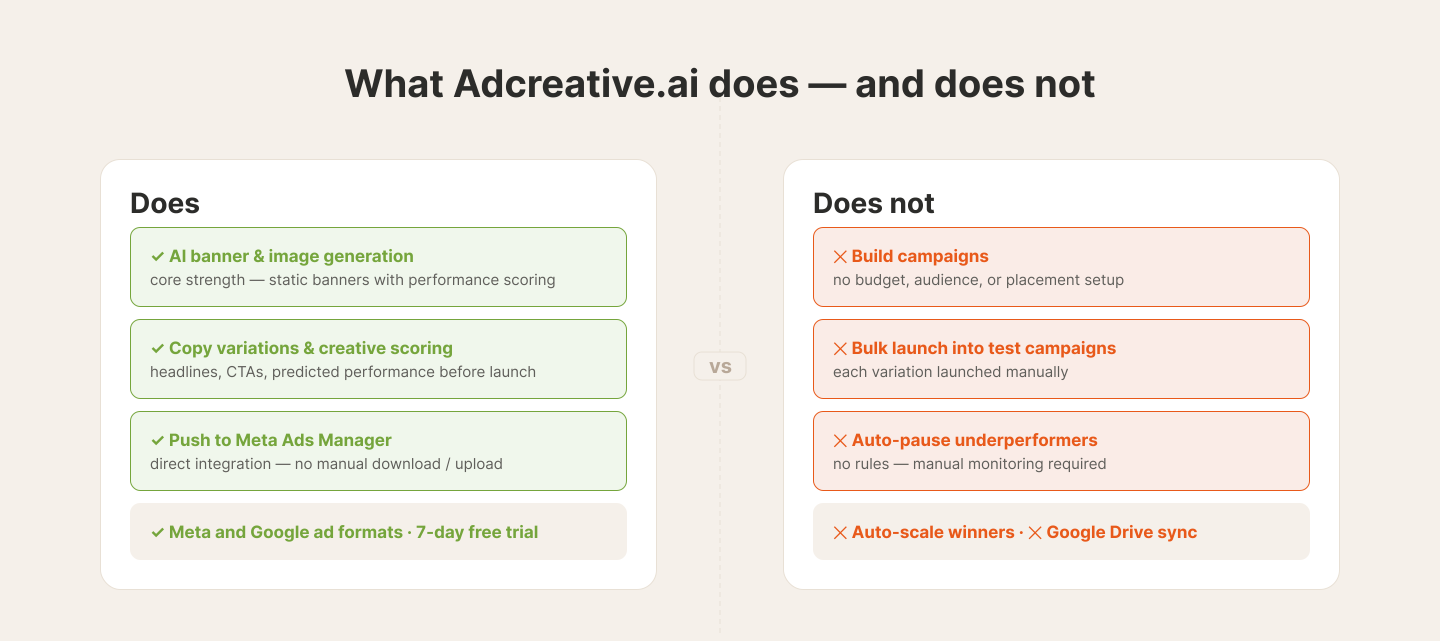
Generating the creative is step one. Everything after that still happens manually.
The platform produces creatives and delivers them to your ad account — but campaign setup, testing, and performance management remain manual. That gap is exactly why teams search for an AdCreative.ai alternative — not because creative generation is bad, but because generating ads is only the first step.
Best AdCreative.ai Alternatives for Creative Generation
These are tools like AdCreative.ai that focus on the same job: producing ad creatives faster. Each one takes a different angle.
Canva AI
AI image generation built into a design platform everyone already knows. Templates for ad formats, brand kits, and quick resizing across placements. The AI features add background generation, text-to-image, and smart resize. Broad market tool — not specialized for performance ads, but accessible and fast for teams that need volume without learning a new platform.
Pencil (by Smartly.io)
AI video ad generation with performance prediction. Pencil analyzes past creative performance and generates new video variations optimized for specific platforms. Predicts which variations will perform before they launch — useful for reducing wasted spend on testing. Enterprise pricing makes it a better fit for larger teams. Now part of Smartly.io.
Creatify
Generates video ads from product URLs. Drop in a link, get AI-generated video ads with voiceover and product footage. UGC-style AI avatars available for talking-head formats. Strong for e-commerce teams that need fast video production without a filming setup.
Arcads
AI UGC video ads with realistic AI avatars. Among AdCreative.ai competitors focused on video, Arcads has the strongest avatars — natural-looking talking-head videos without real actors. Best for teams running UGC-style ads at scale without a production crew.
"Best avatars I've tested. Natural enough that viewers don't register them as AI in the first few seconds." — Creative Marketing Manager
AI Video Generation (Veo 3, Sora, Kling)
For teams that want full control over AI-generated video rather than template-based output. Veo 3 and Sora lead on realistic human animation. Kling is a solid alternative to Runway, which has fallen behind based on user feedback. The workflow: generate a static image with tools like Gemini or Nano Banana, then animate it in Veo 3 or Sora. More effort than template-based tools, but produces unique results that stand out in feeds.
"If you need realistic human animation, nothing else comes close right now. Runway fell behind — Kling gives better results for the same effort." — Creative Marketing Manager
"Generate a static image first, then animate in Veo 3. This pipeline gives you way more control than any template tool." — Creative Marketing Manager
"ElevenLabs quietly shipped video generation too. Worth checking if you already use them for voice." — Creative Marketing Manager
Omneky
Multi-platform AI ad generation from product data. Auto-generates creative variations across formats and platforms. Positioned for teams managing ads across Meta, Google, TikTok, and more — one production source for all channels.
Each of these is a valid AdCreative.ai alternative for the production stage. The question is what happens after the creatives are made.
The Missing Piece: Testing, Analyzing, and Scaling
Producing 50 creatives is roughly 20% of the work. The other 80% is getting them live, tracking what performs, killing losers before they waste budget, and scaling winners before they fatigue.
This is where most creative workflows break down. The creatives sit in a Drive folder. Someone downloads them, uploads to Ads Manager, builds campaigns manually, checks performance twice a day, and pauses underperformers when they remember. That process does not scale.
What a testing system actually needs:
- Bulk launch — push 50 creative variations into test campaigns in minutes, not hours. Bulk ad launch from templates eliminates the manual setup.
- Auto-pause by ROAS or CPI — losers stop spending automatically. Automation rules that pause and scale run 24/7 with built-in rollback.
- Auto-scale winners — budgets increase on performers without waiting for someone to check a dashboard.
- Creative upload from cloud — creatives from Drive go straight to campaigns. A free ad uploader for Google Drive to Meta removes the download-upload-rename cycle.
- Reporting back to the creative team — what elements win, what formats fatigue fastest, what hooks hold attention. Data that shapes the next production round.
For a detailed breakdown of creative testing tools, see best ad testing tools compared. For broader automation context, the 13 Facebook ads automation tools comparison covers the operational side.
Why Creative Volume Matters More Than Creative Quality
Most ad teams treat creatives like portfolio pieces. Weeks go into designing five "perfect" videos. They launch, the results are average, and the cycle starts over. Meanwhile, teams that grow fast take a different approach — they treat creatives like hypotheses and test as many as possible.
The math is straightforward: roughly 1 in 30 to 50 creatives becomes a real winner. Not a decent performer — a winner that scales. Getting to that one requires volume, and volume requires a system: analyze competitors, generate hypotheses, produce creative variations, launch them into campaigns, kill losers fast, and iterate on what works.
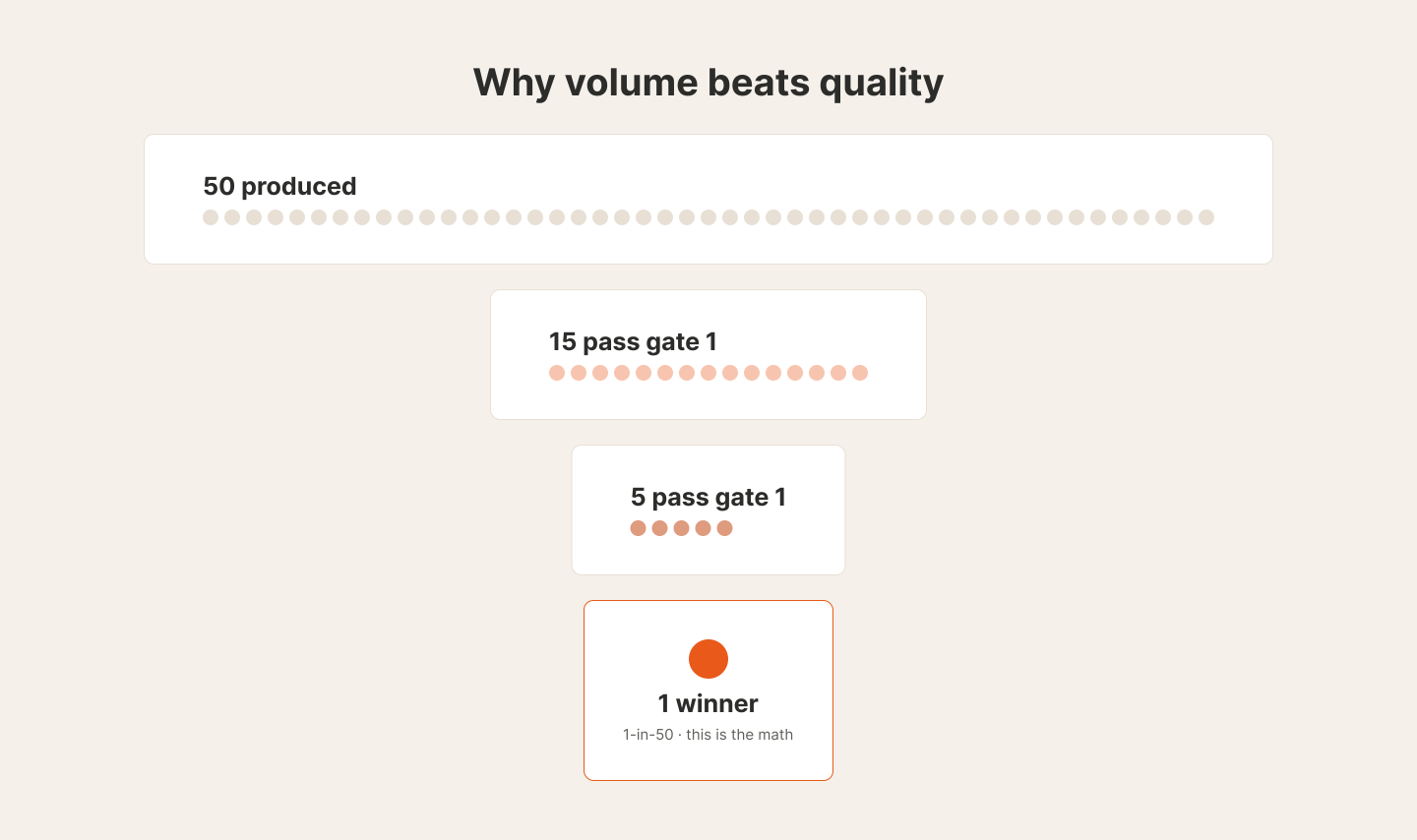
1-in-50 is the real conversion rate. You can't improve that with quality alone.
No single tool handles all of that. Ad creative automation covers the production stage — getting from concept to finished asset. But production without a testing system is just a folder full of unused ads.
Building a Full Creative Testing System
The teams that scale ad spend consistently run a weekly cycle — not a one-off launch. Here is what that cycle looks like in practice:
Monday: Analyze competitors using Meta Ads Library, Foreplay, and Claude for scraping ad libraries directly. Identify patterns, generate hypotheses for new angles, hooks, and formats.
"Claude can scrape Facebook Ads Library directly. Saves hours of manual research." — Creative Marketing Manager
Tuesday through Thursday: Produce creative variations. AdCreative.ai for image ads and copy. Arcads or Creatify for UGC-style video. Veo 3 or Sora for custom AI video. Vizard for transcribing and cutting competitor references into scripts.
"I use Vizard for transcribing competitor ads. Fastest way to turn a winning ad into a script brief." — Creative Marketing Manager
Thursday through Friday: Launch everything into test campaigns. Scalemate bulk launch with Google Drive sync — creatives go from the production folder into live campaigns without manual uploads.
Week-long: Automation rules pause losers and scale winners automatically. No daily manual checks. Rollback protections reverse budget increases if performance drops.
Next Monday: Analyze results. Pull winning elements — which hooks, which formats, which CTAs. Create variations on best performers. Repeat.
Scalemate covers steps three through five. AdCreative.ai covers step two. They do not compete — they are different stages of the same process.
The Full Creative Pipeline — Tools for Each Stage
Rather than picking one AdCreative.ai alternative, the practical move is building a pipeline where each stage has the right tool.
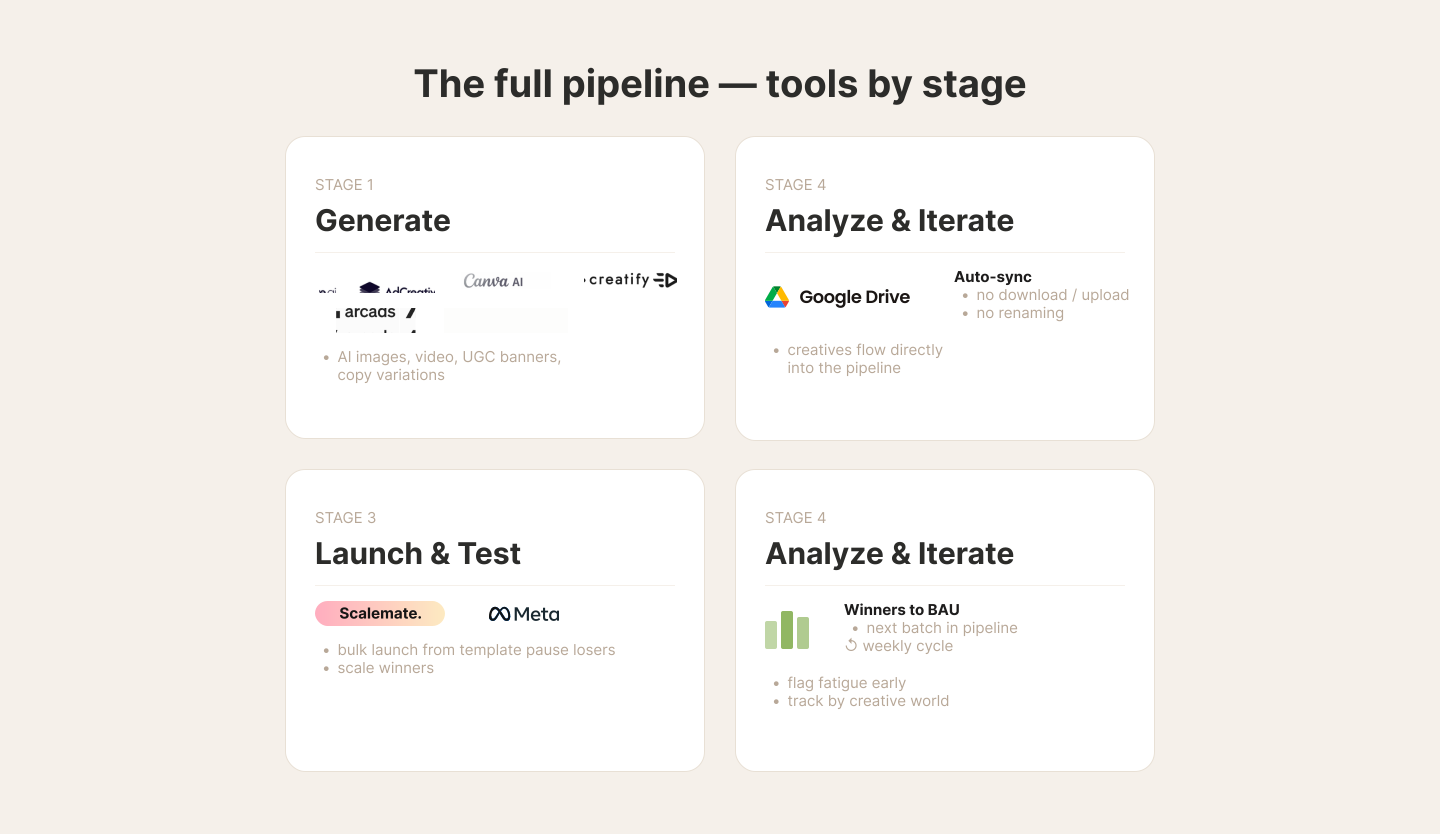
Each stage needs the right tool. Generation tools stop at stage 1.
Research and Analysis Foreplay, Meta Ads Library, Claude (direct ads library scraping), Reddit (topic and angle research)
Scripts and Briefs ChatGPT, Claude, Vizard (transcribe competitor ads into scripts)
Creative Production AdCreative.ai (image ads, copy), Arcads (UGC avatars), Creatify (video from URLs), Veo 3 / Sora (realistic AI animation), Canva AI (templates and quick variations)
Testing, Rotation, and Analysis Scalemate — bulk launch from Google Drive, auto-pause losers, scale winners, AI chat for campaign analysis
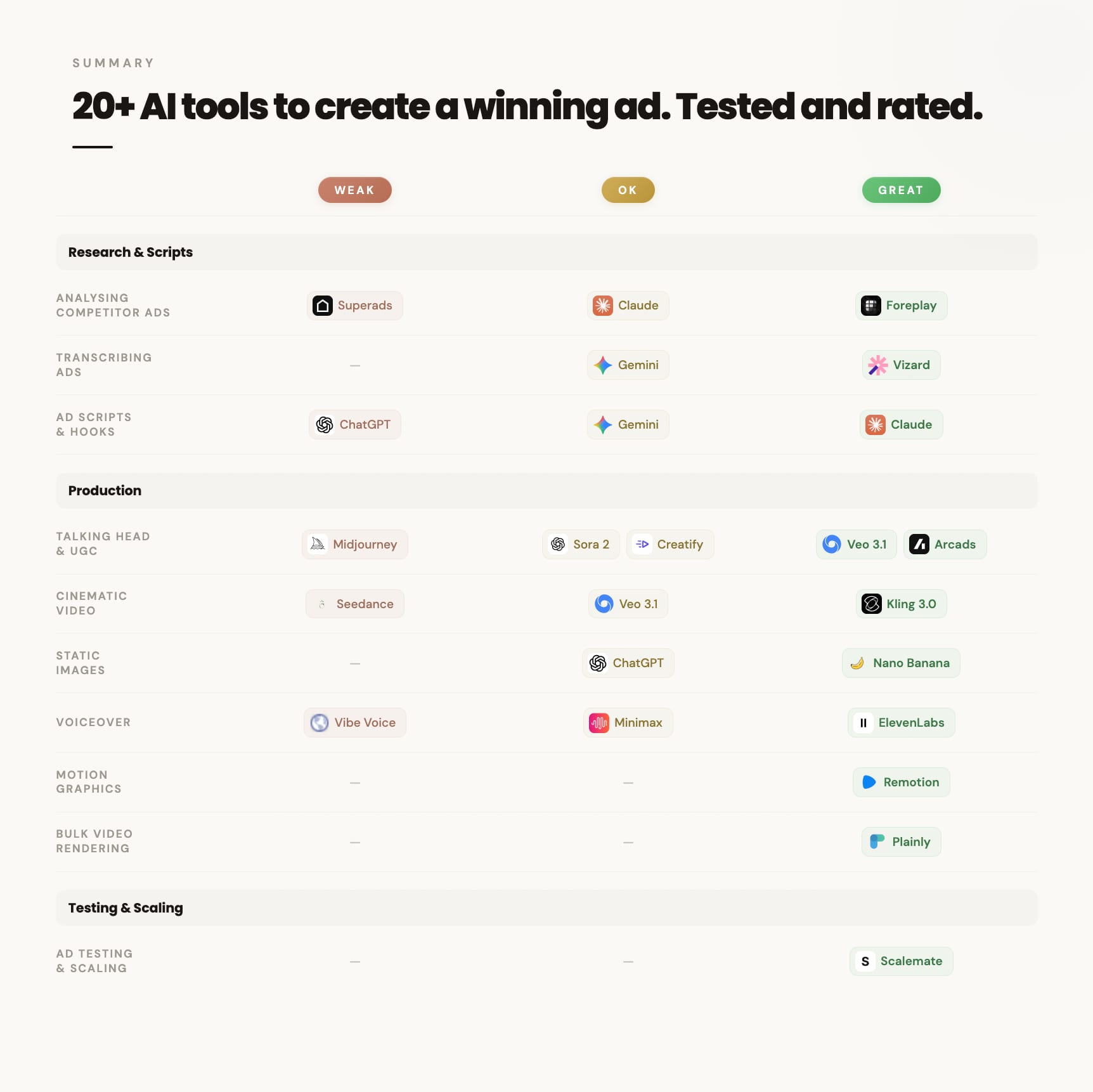
20+ AI tools rated by stage: research, production, and testing.
Each stage uses a different set of tools. AdCreative.ai sits in stage three. Scalemate sits in stage four. Not competitors — different parts of one system that, together, turn creative volume into ad spend growth.