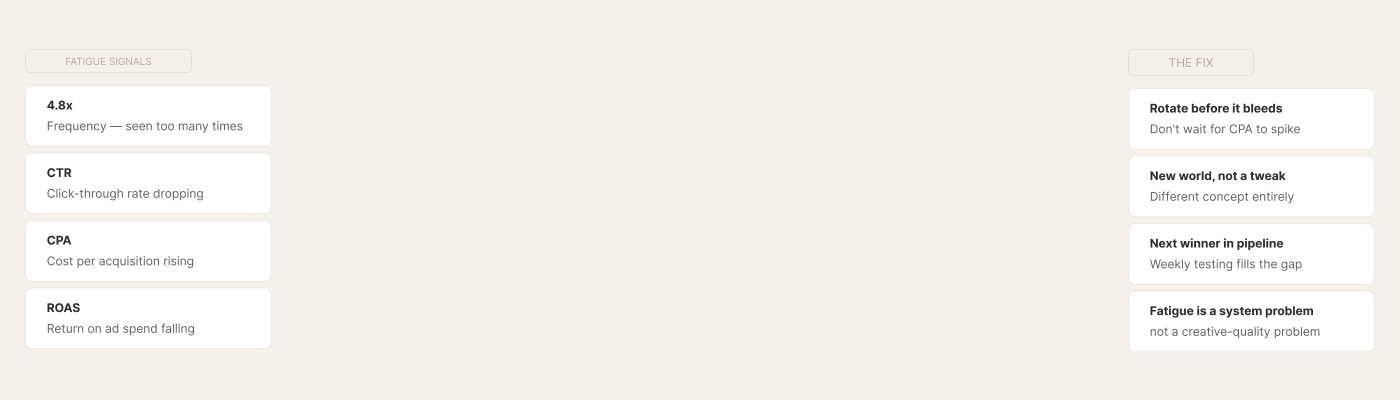
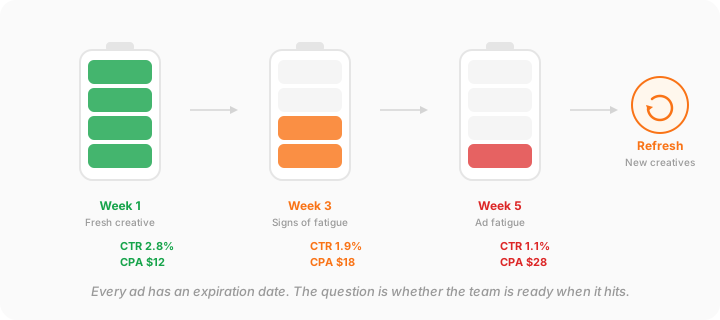
Every ad has an expiration date. It does not matter how strong the creative is, how precise the targeting is, or how well the funnel converts. At some point, performance starts to slide — CTR drops, CPA rises, ROAS compresses. This is ad fatigue, and it is not a bug in the system. It is a built-in feature of every paid media platform. The question is not whether it will happen. The question is whether the team has a system ready when it does.
This article covers what ad fatigue actually means in practice, how to recognize it before the budget bleeds, what causes it at a structural level, and how to build a testing system that keeps performance steady instead of lurching from winner to burnout.
Quick answer: Ad fatigue is when the same audience sees the same ad too many times, so CTR drops, CPA rises, and ROAS falls — even though the creative itself never changed. You fix it by refreshing creatives before current winners burn out: watch for a 20%+ CTR drop from peak and frequency above 3.0, test around 20 new creatives a week to find winners (roughly a 5% hit rate), and set automation rules that pause fatigued ads and scale fresh ones across Meta and TikTok.
In this article:
- What Is Ad Fatigue?
- Signs Your Ads Are Fatiguing
- What Actually Causes Ad Fatigue
- Creative Diversity Rate: Why Changing a Hook Isn't Enough
- The 5% Winner Rate Reality
- How to Build a System That Stays Ahead of Fatigue
- Testing Budget: Separate Campaigns vs Existing Ones
What Is Ad Fatigue?
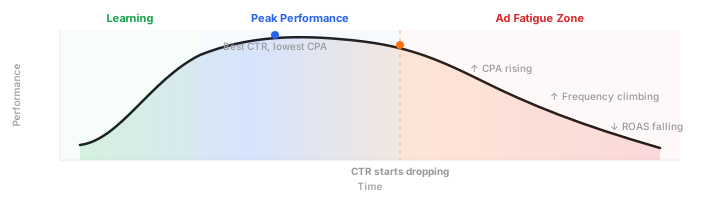
Ad fatigue is what happens when the same audience sees the same ad too many times, causing engagement and conversion metrics to decline. The ad fatigue meaning is straightforward: the creative stops being effective not because it was poorly made, but because the audience has been overexposed to it. CTR falls. CPA climbs. ROAS shrinks. The ad did its job — then it ran out of road.
This is not a one-time problem to solve and move on from. Ad fatigue is a constant cycle that repeats as long as campaigns are running. Every creative, no matter how high-performing, will eventually exhaust its audience. The pattern applies across Meta, TikTok, Google, and every other paid channel. Ad fatigue on Facebook follows the same mechanics as creative fatigue on TikTok — the platform, audience size, and budget determine how fast it happens, but the outcome is always the same.
Understanding what is ad fatigue at a deeper level means accepting that paid media is a creative consumption engine. Audiences consume content, grow familiar with it, and stop responding. The only variable a team controls is how quickly new creatives replace the old ones.
Signs Your Ads Are Fatiguing
Performance rarely falls off a cliff. Ad fatigue shows up gradually, across multiple metrics, and the signs often overlap. Catching it early — before the budget damage compounds — requires watching specific numbers together, not in isolation.
Here are the metrics that signal ad fatigue is setting in:
| Signal | What to watch | Fatigue threshold |
|---|---|---|
| CTR | Drop from peak with no targeting changes | >20% decline from peak |
| Frequency | Prospecting / Retargeting | >3.0 / >5.0 |
| CPA | Rising while funnel stays the same | Consistent climb over 3+ days |
| CPM | Platform charges more as engagement drops | Increasing week-over-week |
| Conv. Rate | Drops while CTR holds steady | Hollow clicks — audience clicks but doesn't convert |
Two or three of these appearing together, especially when nothing else in the campaign has changed, is a clear signal. Teams that automate Facebook ads with rule-based monitoring catch these signals faster than those checking dashboards manually.
What Actually Causes Ad Fatigue
Knowing the signs is useful. Knowing the root causes is what prevents them. Ad fatigue does not appear randomly — it follows predictable patterns tied to campaign structure and creative strategy.
Small audience plus large budget. This is the most common cause and the easiest to diagnose. A narrow audience receiving heavy spend gets saturated quickly. If a retargeting pool of 50,000 people is absorbing $500 per day, frequency climbs fast and creative fatigue sets in within days. The math is simple: fewer people to reach means each person sees the ad more often. Adjusting the ad frequency cap can slow the burn, but it does not fix the underlying imbalance.
Too few creatives in rotation. Platforms optimize toward winners. That is good for short-term efficiency but bad for creative longevity. If an ad set contains three creatives, the algorithm will quickly concentrate spend on one — and exhaust it. The other two barely get tested. Having 10-20 creatives in rotation gives the platform more options to distribute impressions and delays the point where any single creative burns out.
Creatives that look the same. Volume alone does not solve ad fatigue if every creative follows the same template, uses the same visual style, or opens with the same hook. Ten ads that look like variations of one ad still fatigue as a group. The audience perceives them as the same message, and engagement drops across all of them simultaneously. This is where ad creative fatigue becomes a systemic problem rather than an individual ad problem.
No refresh schedule. Teams that launch creatives without a plan for replacing them always end up reactive — scrambling to produce new ads after performance has already cratered. By the time a replacement is live, the damage is done. A consistent refresh cadence, tied to performance data rather than a calendar, keeps the pipeline ahead of the decay curve.
Creative Diversity Rate: Why Changing a Hook Isn't Enough
Swapping a headline or changing the first three seconds of a video feels like a refresh. To the algorithm, it often is not. Both Meta and TikTok use creative diversity scoring to evaluate how different a new ad is from existing creatives in the same account. This system directly impacts delivery.
The creative diversity rate determines how much distribution a new creative receives. Ads that are more than 80% similar to existing creatives — in visual composition, structure, or content — may receive reduced impressions and lower spend allocation from the platform. The algorithm is not just comparing text. It analyzes visual layout, color patterns, scene structure, and audio. A UGC video with the same creator, same background, and same product angle but a different script often scores as a near-duplicate. This is a core part of how facebook creative fatigue compounds — what looks like five different ads to a media buyer looks like one ad to the algorithm.
This is why minor variations fail to solve creative fatigue. The creative fatigue meaning extends beyond audience perception to platform mechanics. Even if users cannot articulate why an ad feels stale, the platform's scoring system has already flagged it.
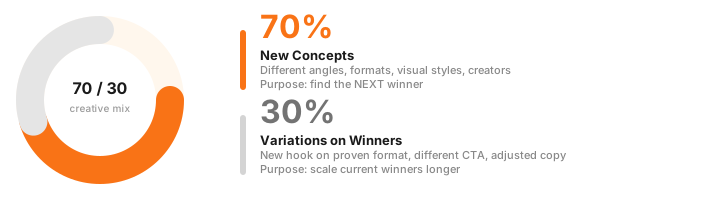
The practical framework:
| New Concepts (70%) | Variations (30%) | |
|---|---|---|
| What | Different format, angle, visual style, creator | Iterate on proven winners — new hook, different CTA |
| Why | Find the NEXT winner | Scale current winners longer |
| Risk if missing | Pipeline dies when current winners fatigue | Winning creatives don't reach full potential |
Teams that invert this ratio — running mostly variations with a few new ideas — find themselves constantly battling creative fatigue ads that the platform will not distribute.
TikTok's creative best practices emphasize native-feeling content with high diversity, and their delivery system actively rewards accounts that maintain a varied creative library. The same principle applies on Meta, though the documentation is less explicit about the scoring mechanism. For teams exploring AI-generated creative options, AdCreative.ai and alternatives can help produce volume — but diversity of concept still needs to come from human strategy.
The 5% Winner Rate Reality
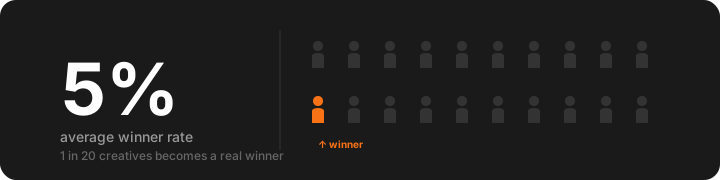
Here is the number that reframes the entire creative testing conversation: roughly 5% of creatives become genuine winners. One in twenty. That means launching two or three new ads and hoping for a hit is not a strategy — it is a coin flip with bad odds.
This winner rate holds across industries and platforms. Some accounts run higher, some lower, but 5% is a reliable baseline for planning. It means a team that needs three active winners at any given time should be testing 60 creatives to find them. Not simultaneously, but over the testing cycle that feeds the pipeline.
The implication is that creative testing cannot be a side project. It needs to run parallel to BAU (business as usual) campaigns — continuously, with dedicated budget and a clear process. For a full walkthrough of how to structure that process, see our creative testing system. The worst version of how to solve creative fatigue is waiting for current winners to burn out, then scrambling to produce replacements. If CTR has already dropped, the team is one to two weeks behind. The damage to CPA and ROAS during that gap is real money lost.
The better approach: test new creatives in parallel so that promising ads are identified and ready before the current top performers exhaust their audience. When a winner starts showing fatigue signals, the replacement is already warmed up. There is no gap, no scramble, no emergency creative brief sent to the design team on a Friday afternoon.
Maintaining this velocity requires tooling. Manual ad creation — building each variation one at a time in Ads Manager — becomes the bottleneck long before creative production does. Tools that support bulk ad launch from templates collapse the build time from hours to minutes, making it feasible to launch 20-50 variations in a single batch. For a comparison of options, see the guide to best ad testing tools.
How to Build a System That Stays Ahead of Fatigue
The difference between teams that struggle with ad fatigue and teams that treat it as a solved problem is not talent or budget. It is process. A weekly creative cycle, repeated consistently, keeps the pipeline ahead of burnout.
The cycle:
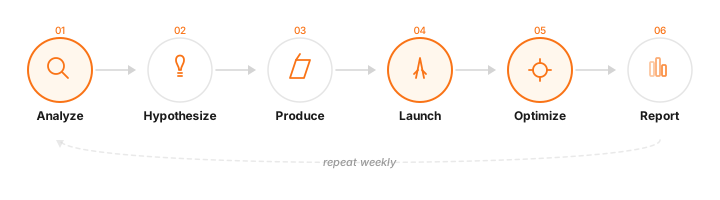
| Step | What happens | Tools |
|---|---|---|
| Analyze | Review what fatigued, what competitors launched | Meta Ad Library, Foreplay |
| Hypothesize | 70% new concepts, 30% variations | Team strategy |
| Produce | Build assets | AI tools or in-house design |
| Launch | 20-50 variations at once | Bulk ad launch + ad uploader |
| Optimize | Auto-pause losers, scale winners 24/7 | Automation rules |
| Report | Feed results back to creative team | AI Chat or BI dashboard |
This runs weekly. Skipping a week creates a pipeline gap that takes two to three weeks to recover from. For a detailed breakdown of tools and frameworks for each stage, see best ad testing tools.
Testing Budget: Separate Campaigns vs Existing Ones
| $20K+/mo | Under $20K/mo | |
|---|---|---|
| Where to test | Dedicated testing campaigns, separate from BAU | Add new creatives into existing campaigns |
| Budget split | 10-20% of total for testing | ~10-15% mentally earmarked |
| New ads per week | 20-50 variations per batch | 2-3 per ad set |
| Data quality | Clean — new creatives compete against each other | Mixed — new ads compete with proven winners |
| Winner path | Graduate from testing → BAU/scaling | Scale within same campaign |
| Kill timeline | Auto-pause within 48-72 hours | Monitor first 48 hours manually or with rules |
| Expected output | 1-2 winners per week at 5% rate | ~1 winner every 1-2 months |