"Should we run statics or video?" is the question most teams open with, and it's not where the money leaks. You can launch 20 statics into one ad set on Monday, and by Wednesday the algorithm has quietly funneled almost all the budget into one or two of them, leaving the rest to spend pennies and never gather enough data to prove anything. That happens whether the creative is a static, a video, or a carousel. The format gets you into the game; how many angles you test and where the algorithm sends the spend decide who actually wins.
This article covers what a static ad actually is, the types worth knowing, an honest read on static versus video, and the part nobody else writes about: how to test and scale a high-volume static portfolio so Meta doesn't waste two-thirds of your spend on creatives it never gives a chance.
Quick answer: A static ad is a single non-moving image ad — one frame, no animation. Statics are winning attention again in 2026 because they're the cheapest, fastest way to test angles at the volume Meta's Andromeda algorithm now demands. But a winning angle is only half the job. Across roughly 3,000 ad sets we analyzed, the top one or two creatives captured an average of 87% of ad-set spend, and 70%+ of creatives never received meaningful budget at all. So the other half is reading where the spend lands, telling a true loser from an under-tested creative, and refreshing before the winner fatigues.
In this article:
- What is a static ad?
- What are the types of static ads?
- Why static ads are winning on Meta in 2026
- Why static ads plateau (and how to read the signals)
- Do video ads perform better than static ads?
- Static vs dynamic ads
- The hidden cost: zombie creatives and zero-spend ads
- Data study: spend distribution across ~3,000 ad sets
- How to judge the real winner: blended ROAS vs in-platform ROAS%
- How to test and launch statics at volume
What is a static ad?
A static ad is a single, non-moving image ad: one frame, no video and no animation. On Meta and TikTok it's typically a 1:1, 4:5, or 9:16 image paired with a headline, primary text, and a call-to-action button. That's the whole definition. If it doesn't move, it's a static.
The reason the term exists at all is to separate it from the formats that do move: video ads, GIFs, and carousels (which hold multiple frames the user swipes through). A static is the simplest possible creative unit, which is exactly why it's underrated. It's the cheapest and fastest thing you can produce, and in 2026 the cheapest unit of creative volume turns out to be the one the algorithm is hungriest for.
We've launched and watched millions of ads across paid accounts, and the pattern is consistent: teams obsess over the perfect static and under-invest in producing enough of them. Contrary to the usual "great creative wins" advice, the format and the polish aren't where most accounts lose money. They lose it in distribution, which we'll get to.
What are the types of static ads?
There's no official taxonomy, but after enough accounts you start sorting statics into a handful of recognizable archetypes. What separates them isn't the layout; it's the job each one does and the pain it speaks to, which is why they behave so differently in delivery: some scale to cold audiences, some only convert warm traffic. Describing them this way is more useful than a swipe file.
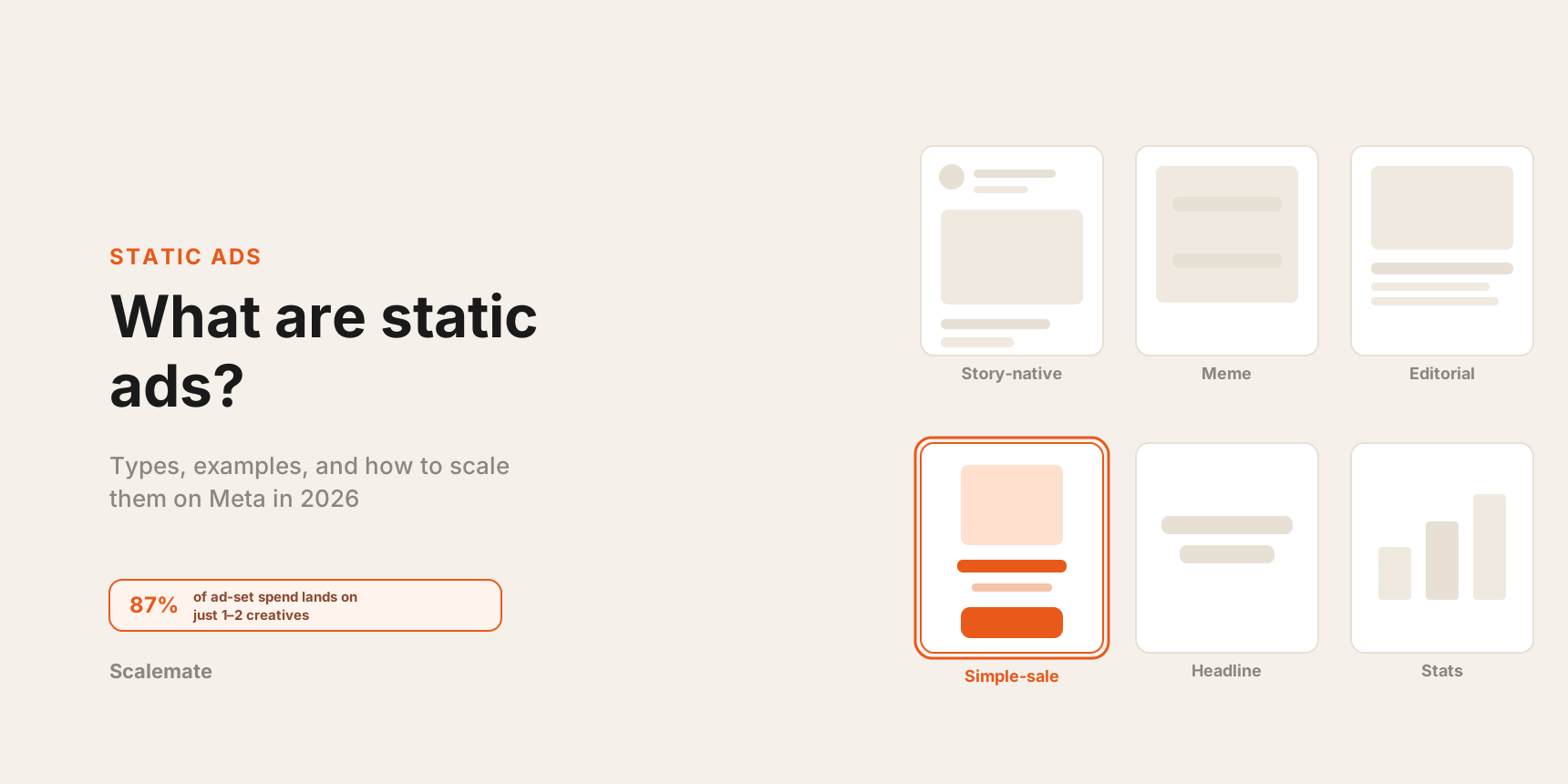
Here are the six that come up most:
| Type | What it looks like | The job / pain it speaks to | Best for |
|---|---|---|---|
| Story-native (IG-style) | Looks like organic content — casual photo, native text overlay, no obvious "ad" frame | "I don't want to be sold to" — slips past the ad-radar of someone who doesn't know you yet | Cold / top-of-funnel — blends into the feed, scales well |
| Meme / scroll-stopper | Pattern-interrupt visual, humor or shock, low production polish | Boredom and "this is so me" — earns a stop through humor or in-group recognition | Cold — built to halt the scroll and earn cheap attention |
| Magazine / editorial | Clean, brand-led layout, strong typography, premium feel | "Is this brand legit?" — signals quality and credibility | Brand-aware audiences; consistency over disruption |
| Simple-sale | Product shot + offer + CTA, minimal copy | "Just show me the product and the deal" — for someone already ready to act | Warm / product-aware — converts people who already know you |
| Simple-headline / results | One bold claim or outcome on a plain background | The outcome they actually want — the promise alone carries it | Warm — works when the promise alone does the selling |
| Stats / comparison | Before-after, us-vs-them, or a data callout | "Why you over the option I'm already weighing?" — settles the comparison | Warm / bottom-of-funnel — closes the people comparing options |
To make those concrete, here are quick static ad examples of each, kept generic so you can map them to your own product:
- Story-native: a habit-tracker app posts a phone screenshot with a casual, hand-typed caption, like a friend recommending it.
- Meme / scroll-stopper: a B2B tool turns Monday-morning inbox dread into a meme with a two-line punchline.
- Magazine / editorial: a DTC coffee brand runs a clean flat-lay, a serif headline, and one benefit line.
- Simple-sale: an online store shows the product, "30% off this week," and a Shop Now button.
- Simple-headline / results: a project tool puts a single line ("Ship releases 2× faster") on a solid color.
- Stats / comparison: a fintech app sets the old way against its own side by side, or runs a single "4.9 stars from 12,000 reviews" callout.
The split that matters operationally: story-native and meme formats lean top-of-funnel and scalable (they earn cheap attention from people who don't know you yet), while simple-sale, stats, and comparison formats lean bottom-of-funnel (they convert people already considering you). In our experience, the mistake isn't picking the "wrong" type. It's running only one. A portfolio that mixes a couple of cold-scalable archetypes with a couple of warm-converting ones gives the algorithm more shapes of signal to work with.
We're deliberately not turning this into a design tutorial. How to write the headline or lay out the pixels is a creative-production question, and it's not where the spend leaks. The leak is volume and distribution.
Why static ads are winning on Meta in 2026
For years the advice was "video or die." That flipped, and the reason is mechanical, not aesthetic.
Meta's Andromeda retrieval engine (the deep-learning system that decides which ad to show whom) rewards creative volume and diversity over tight audience targeting. Meta's own published outcome numbers from the Andromeda rollout report +8% ads quality, and its Advantage+ image generation tools showed +11% CTR and +7.6% CVR in Meta's testing (Meta for Business, 2025). The practical translation: the algorithm wants a steady supply of varied creatives, and it will find the audience for each one.
Statics are the cheapest, fastest way to supply that volume. Here's the rough economics we see in practice (directional, not a benchmark):
| Creative unit | Rough cost each |
|---|---|
| Static (AI-assisted) | ~$5-15 |
| Video (AI-assisted) | ~$20-50 (and it often underperforms) |
| UGC video (self-sourced) | from ~$100, region-dependent |
| UGC video (US creator + agency) | $250+ |
A cheap video costs 2-10x a static; a good UGC video, 20-50x. So if the algorithm wants 15-20 creatives per ad set, statics are the format that makes that volume affordable for everyone, not just teams with a video budget. (That 15-20 figure is practitioner consensus, not a Meta rule; Meta retired its old 6-ads-per-ad-set cap in early 2025 and doesn't publish a target count.)
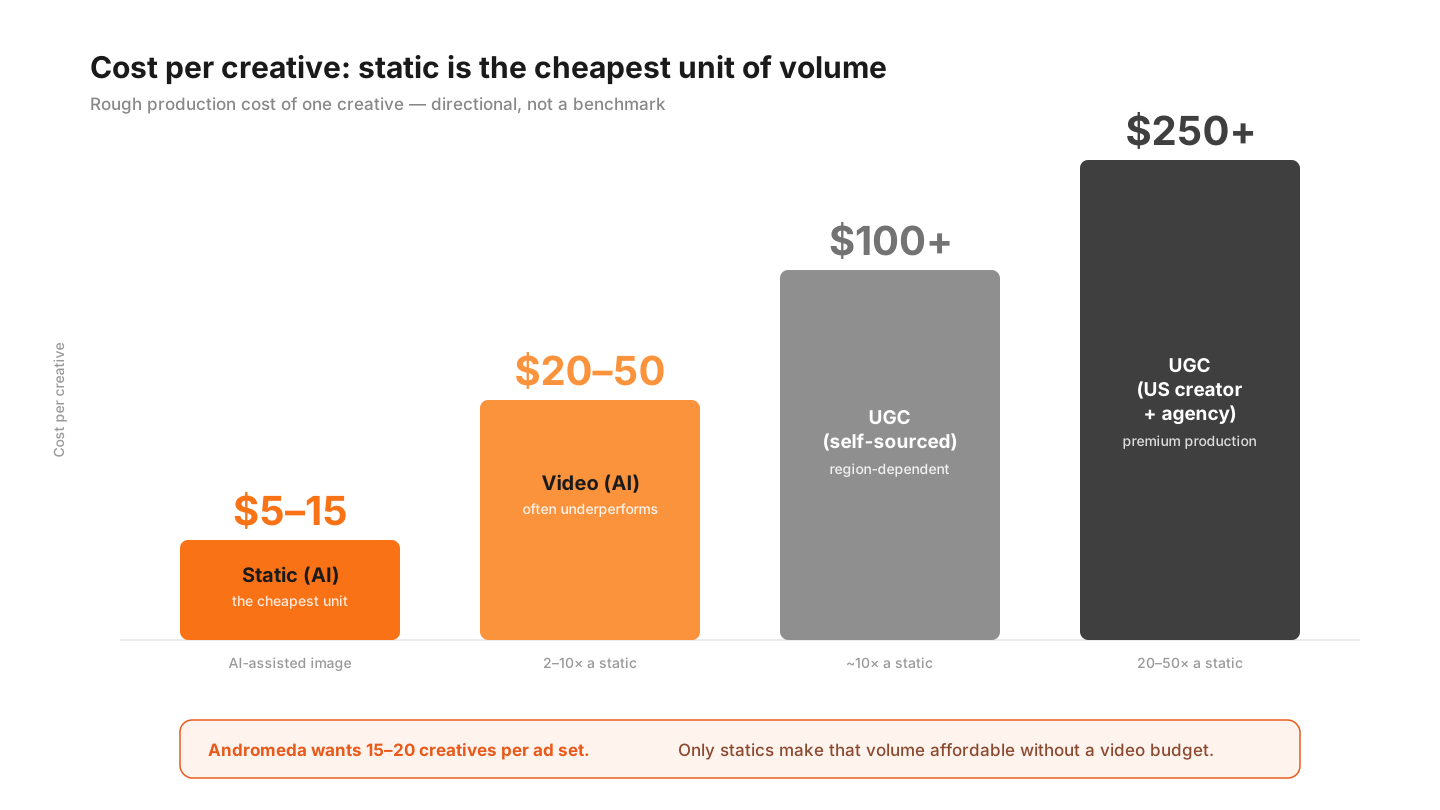
A static is 2–50× cheaper than video — the only format that makes 15–20 creatives per ad set affordable
This is where the popular narrative stops, and it's exactly the wrong place to stop. "Statics are cheap, so make a lot of them" is only half the story. Production was never really the bottleneck; even at $10 a static, you can afford the volume. The real bottleneck is that the algorithm funds only one or two of those statics and starves the rest. For the full mechanics of why Andromeda made creative volume the #1 lever, see our Meta Andromeda breakdown.
Why static ads plateau (and how to read the signals)
Here's the pattern that catches teams off guard: a static works, you push more budget at it, and ROAS falls. The instinct is to blame the creative. Usually it's the audience. The algorithm has already optimized that static toward the small pocket of warm, product-aware people most likely to convert; once you spend past them, frequency climbs, reach stalls, and you're just re-burning the same audience at a rising price.
Statics hit that wall faster than video. Segwise's 2026 analysis puts the static refresh cycle at roughly 20-30 days versus 40-60 for video, so statics fatigue 30-50% faster (Segwise, 2026). The signal to watch isn't a fixed "refresh every X days" number; it's rising frequency while reach flattens, with CPA climbing on no funnel change. Treat that combo as the ceiling, and refresh before it, not after. The full diagnostic playbook lives in what ad fatigue is and how to get ahead of it.
Do video ads perform better than static ads?
Not by default — and the honest answer depends on where in the funnel you're looking.
The cleanest recent dataset comes from Segwise, which analyzed creative mix across Meta ads. Treat it as a single-vendor signal (medium confidence), not a universal law:
| Metric | Static | Video | Source |
|---|---|---|---|
| Share of creative mix | 61% | 39% | Segwise, 2026 |
| Click-through rate | 1.1% | 1.9% | Segwise, 2026 |
| Cost per acquisition | $34.50 | $48.20 | Segwise, 2026 |
| Fatigue speed | slower (40-60 day refresh) | faster — statics fatigue 30-50% faster (20-30 day refresh) | Segwise, 2026 |
Source: Segwise, "Static vs. Video Ratio in Meta Ads," 2026, based on roughly 67,000 ads.
Read it by job, not by winner. Video earns the higher click-through and tends to do more of the cold-audience prospecting, pulling in people who don't know you. Statics win on cost-efficiency and quietly close the conversion, often at a lower CPA. The trade-off: statics fatigue faster, so they need refreshing on a tighter cycle.
POV: the "which is better" framing is a trap. The accounts we see win run both, in the same campaign, and let the algorithm decide the mix, exactly what Andromeda is built to do. A static-only or video-only account is leaving signal on the table. (Note Segwise's own caveat: this is one vendor's dataset, and your mix will vary by vertical, offer, and audience temperature. Results vary by account, niche, and budget.)
Static vs dynamic ads
"Dynamic" gets confused with "video," but it's a different axis entirely. A static ad is one fixed image. A dynamic ad is templated or catalog-driven: the platform assembles the creative on the fly, often pulling product images, prices, and copy from a feed and personalizing them per viewer (think Advantage+ catalog ads / dynamic product ads).
| Static ad | Dynamic ad | |
|---|---|---|
| Creative | One fixed image you design and upload | Auto-assembled from a product feed / template |
| Personalization | Same image for everyone in the audience | Tailored per viewer (product, price, copy) |
| Best fit | Awareness, single-offer, brand, testing concepts | Large catalogs, retargeting, e-commerce SKUs |
| Production effort | Manual per creative | Set up the feed and template once, scales automatically |
| Control | Full control of the exact frame | Less control of any single combination |
They're not competitors; most mature accounts run both. Statics are how you test concepts and own the top of the funnel; dynamic ads are how you scale a large catalog and retarget at the bottom. If you have ten SKUs and a clean feed, dynamic ads do work statics can't. If you're testing which concept resonates, a static gives you the clean read.
The hidden cost: zombie creatives and zero-spend ads
This is the part the format debate misses entirely, and it's where most spend actually leaks.
When you launch a batch of statics into a broad Advantage+ ad set, the algorithm doesn't spread budget evenly to find the best one. It picks fast, often within a day or two, and pours spend into one or two creatives while the rest get a trickle. Those starved creatives are zombies: live, spending, but never accumulating enough data to be evaluated. They look like a test. They're not. They're a line item.
This is the default behavior of broad targeting (the full numbers are in the data study below), and it's why you can't run high creative volume blind. The volume only pays off if you can see the distribution and redistribute when it's lopsided.
One nuance trips people up: a low-spend creative isn't automatically dead weight. A cold-audience assist can show low spend yet quietly feed your warm winners, so spend alone won't tell you which is which. We come back to how to separate a true zombie from a quiet contributor below.
The fix that directly attacks this is a loss-cap rule that auto-pauses any ad once it spends past roughly 1.5× your target CPA without a single conversion:
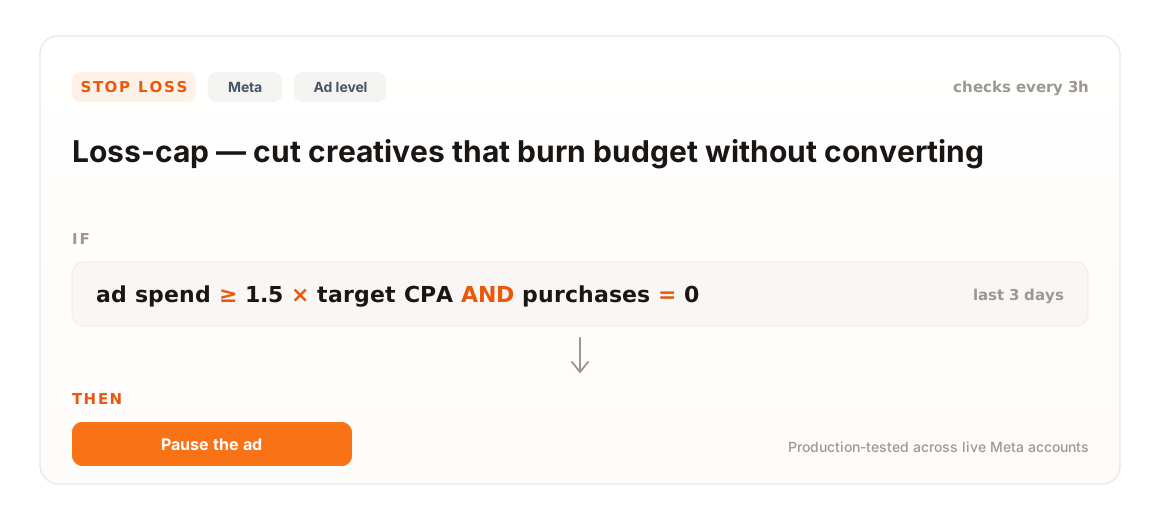
One of 30+ ready-to-use rules in the automation rules library →
That claws budget back from the one or two creatives the algorithm over-funds and forces a fairer test across the rest, which is the lever that brings the zombie rate down. Because it triggers on high spend, it won't catch a low-spend cold assist, so the quiet contributor from above survives. It's analysis-and-automation work, not a creative fix. This is how a team like Appflame runs it: their automation rules auto-pause roughly 754 losing ads a month on Meta, cutting weak variants fast so they can "test more creatives inside one ad set, even when Meta tries to over-push a single creative."
Data study: spend distribution across ~3,000 ad sets
To put hard numbers on the zombie problem, we analyzed our own account data, the kind of first-party read competitors writing about statics don't have.
Methodology: ~3,000 ad sets across 25 accounts, spanning gaming, e-commerce, and subscription-app verticals, running on both mobile and web, over the trailing six months (December 2025 – June 2026). Client identities are under NDA, so we report by vertical only, never by name.
Finding 1, spend concentration. The top one or two creatives in an ad set captured 70-90% of ad-set spend, averaging 87%. In other words, no matter how many statics you launch, the algorithm tends to bet almost everything on one or two of them. Provenance: first-party (gaming / e-commerce / subscription), n ≈ 3,000 ad sets / 25 accounts, Dec 2025 – Jun 2026.
Finding 2, zombie rate. 70%+ of creatives received less than 5% of ad-set spend and so never gathered evaluable data. With deliberate structure (controlled creative counts, budget floors per creative, and rule-based redistribution), we see that fall to a target of under 20-30%. Provenance: first-party (gaming / e-commerce / subscription), n ≈ 3,000 ad sets / 25 accounts, Dec 2025 – Jun 2026.
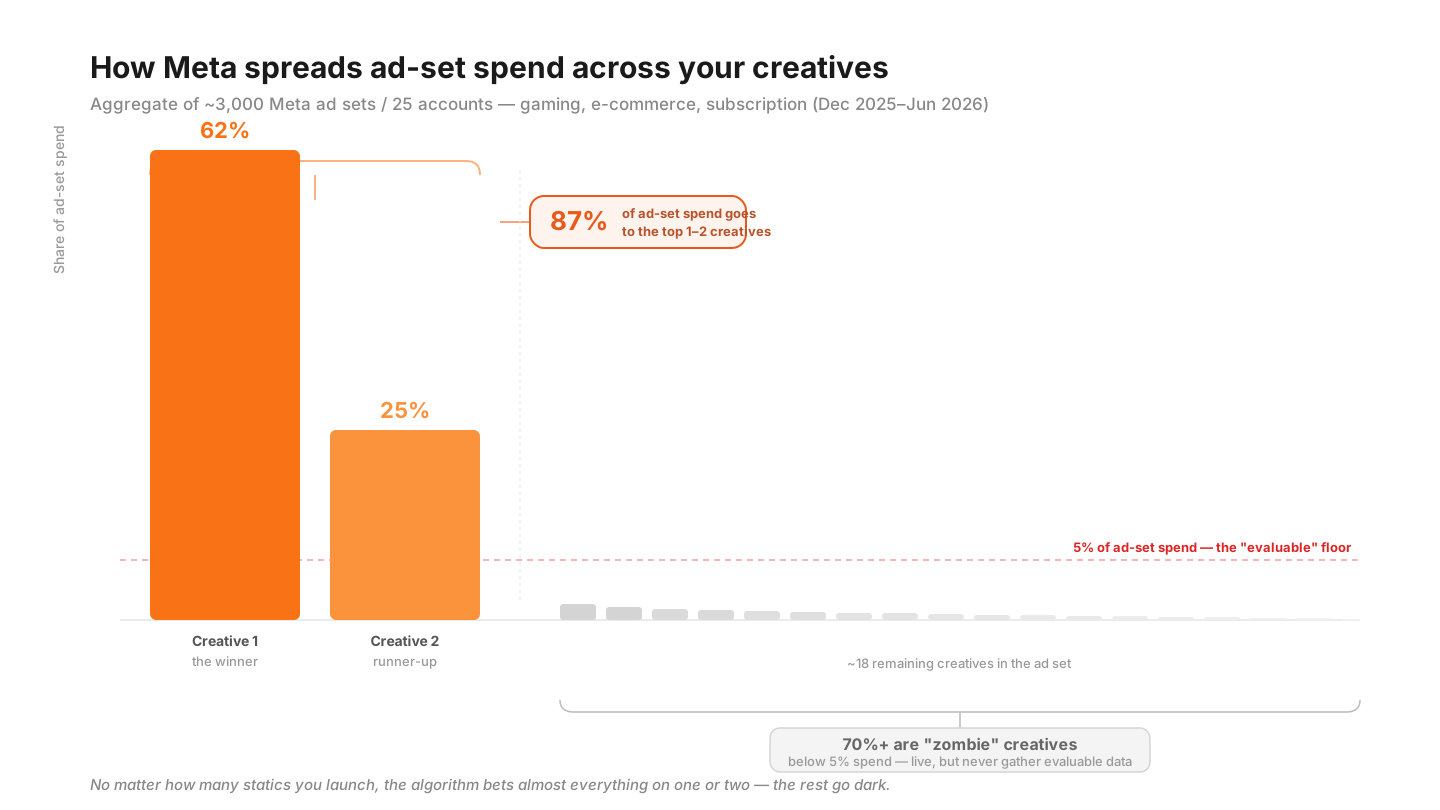
Launch 20 statics and the algorithm bets 87% on one or two — the other 70%+ go dark before they can be judged
We're not alone in seeing this. AppsFlyer's "State of Creative Optimization: 2025 edition" (1.1 million creative variations across 1,300+ apps and $2.4B in spend) found the top 2% of gaming creatives drive 53% of spend (AppsFlyer, 2025 edition). Same concentration at the industry level, and our ad-set-level numbers are the sharper version of it: 87% into one or two creatives versus 53% into the top 2%. Provenance: public (AppsFlyer, 2025 edition), 1.1M creative variations / 1,300+ apps / $2.4B spend — external corroboration, not part of the first-party dataset above.
The public benchmarks each show a piece — Segwise (statics cheaper per acquisition), Meta (the algorithm wants volume), AppsFlyer (industry-wide concentration). Our data shows the part that pays: volume only converts to results if you fix the distribution.
Cite this study: Scalemate, "Static-ad spend distribution across ~3,000 Meta ad sets" (2026). Top 1-2 creatives capture an average of 87% of ad-set spend; 70%+ of creatives fall below 5% of ad-set spend and never gather evaluable data. First-party data across 25 accounts (gaming, e-commerce, subscription), mobile and web, Dec 2025 – Jun 2026.
Standard caveat: these are aggregates from our own accounts. Results vary by account structure, vertical, audience size, and budget. The numbers describe the pattern of algorithmic spend concentration, not a guaranteed split for any single ad set.
How to judge the real winner: blended ROAS vs in-platform ROAS%
If 87% of spend lands on one or two creatives, you'd better be sure the algorithm bet on the right ones. Meta's in-platform ROAS number is the wrong scoreboard for that.
Here's the trap. Meta credits the conversion to the last click. A cold, top-of-funnel static that introduces someone to your brand, and genuinely assists the eventual sale, shows a fake-low in-platform ROAS because the closing click went to a different ad. Judge that assist creative on its in-platform number, pause it, and you dry up the funnel that was feeding your "winners." The winners then decline, and you've no idea why.
The fix is to judge contribution at the account level: blended ROAS, or net cash contribution, across the whole account, not the ROAS% on any single ad. A multi-touch attribution analysis by Singular found that re-crediting assists this way can show up to 50% higher ROAS on Meta versus last-touch, because last-click systematically under-credits cold and assist creatives (Singular, 2026). (Singular's dataset skews gaming/mobile, so read it as "MTA re-credits up to 50% more ROAS to channels last-click misses," not a universal upper-funnel uplift.)
This is also why a low-spend, low-in-platform-ROAS static can be your most valuable assist creative: the account-level lens and the frequency lens together are how you separate a genuine zombie from a quiet contributor. The principle holds across accounts: kill on contribution, not on the in-platform percentage. Frequency is what makes that judgeable as a rule. A creative still sitting at low frequency hasn't had its shot yet, so a smart pruning rule keeps any ad whose 7-day frequency is under ~1.5, even when its in-platform ROAS looks low, instead of pausing it:
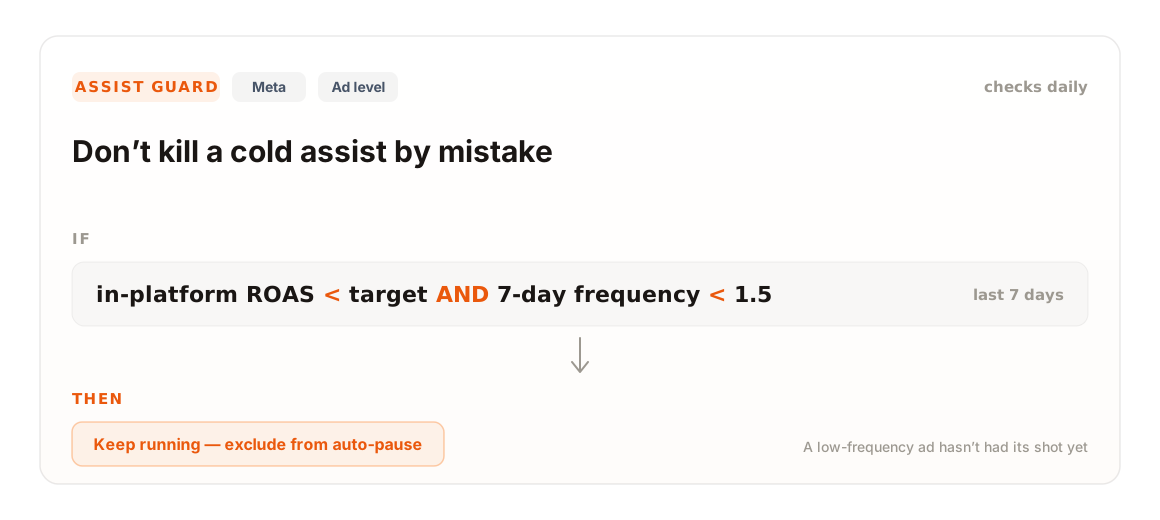
How to test and launch statics at volume
Everything above points to one operational job: launch enough statics, then read where the spend actually goes, fast enough to redistribute before the zombies eat your budget. That's not a creative problem. It's a workflow problem.
Before the workflow, one architectural choice decides how much the algorithm can starve in the first place: how you split creatives across ad sets. Two structures work, and the right one depends on your budget.
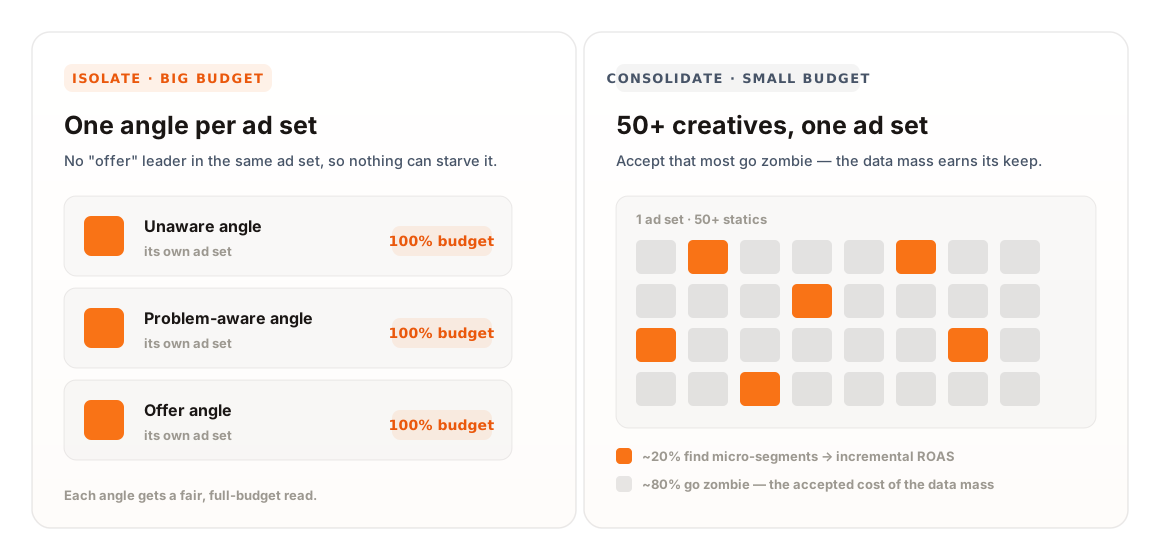
Isolate angles — bigger budgets. Give each angle its own ad set: the unaware hook in one, the problem-aware angle in another, the offer-led creative in a third. With no "offer" leader sitting in the same ad set to vacuum up delivery, Meta is forced to spend that ad set's full budget on the angle you're actually testing. You get a clean, fully-funded read on each angle instead of one creative eating everything.
Consolidate volume — smaller budgets. If you can't fund many ad sets, do the opposite: bulk-launch 50+ statics into one ad set and accept up front that most will go zombie. The trade is deliberate. With that much creative to draw from, Meta's retrieval finds the micro-segments for the ~20% that land, and those deliver steady incremental ROAS. You're buying breadth of signal, not a fair test on every creative.
The four habits below make either structure pay off, and they're all workflow, not creative polish:
- Launch volume without the copy-paste tax. Hand-building 20 statics per ad set across Meta and TikTok in Ads Manager is hours of mechanical work, which is why most teams quietly run 4 and call it a test. Bulk ad launch ships the full batch from reusable templates in one pass, so the volume the algorithm wants is achievable in a workday, and automating the creative upload straight from Drive makes the per-ad-set count practical week after week.
- See the spend distribution early. Within the first day or two, check which one or two creatives are taking the 87% and which are starving. That's your signal to redistribute budget, raise a budget floor, or cut a true zombie. The frequency check tells you whether a low-spend creative is dead or quietly assisting.
- Pick a test structure that fits your budget. There's no single right method; the right one depends on your daily spend and how much clean data you need. We cover the trade-offs across thirteen methods in our creative testing framework library. For high-volume statics, the methods that isolate new creatives with a budget floor (so each one clears the impression threshold to be judged) are the ones that beat the zombie problem. For tooling to read the results, see our roundup of the best ad testing tools.
- Close the winner-to-next-round loop automatically. The slow part of most teams' cycle isn't producing the next static; it's noticing the last test produced a winner. Build a rule that fires the moment a creative clears your win threshold (say, target ROAS with at least 5 purchases) and pings the team or triggers the next step in your pipeline. Scope boundary: our automation rules orchestrate the signal (detect the winner, pause the losers, fire the trigger); your own stack (Gemini or whatever you run) generates the creative off that signal.
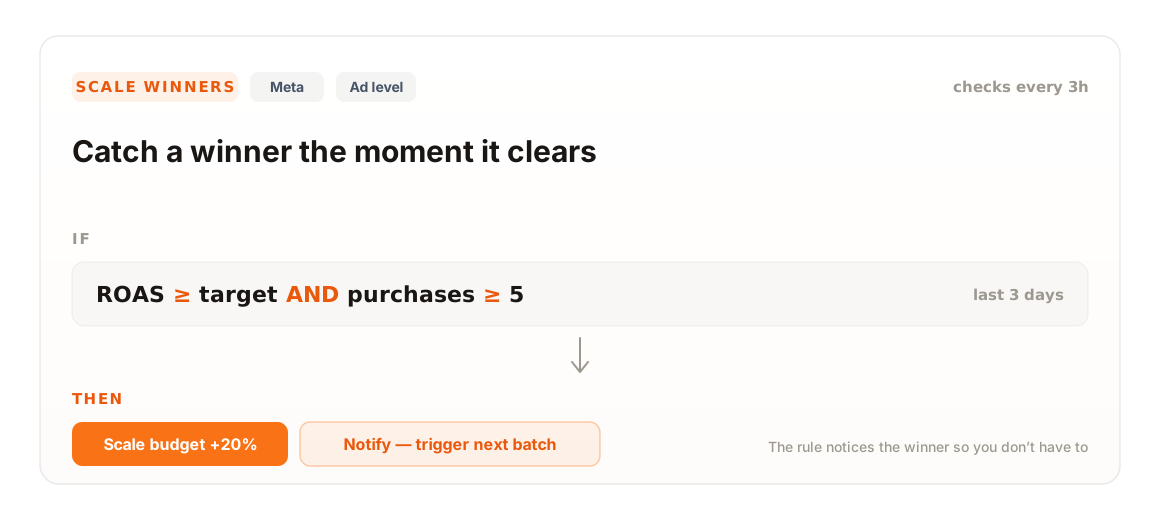
On scaling, tie budget moves to frequency, not to a calendar. While weekly frequency sits around 1-2 you have headroom to raise budget; once it climbs toward 4, raising budget mostly re-burns the warm pocket you already converted. Frequency climbing while reach flattens is the saturation signal from the plateau section, so the move is to add fresh top-of-funnel statics before you raise the budget, not after.
That's the whole game with statics in 2026: the format is the easy part. Launch the volume, watch the distribution, judge on contribution, and refresh on frequency. Do that and the algorithm works for you instead of quietly spending 87% of your budget on a coin-flip.